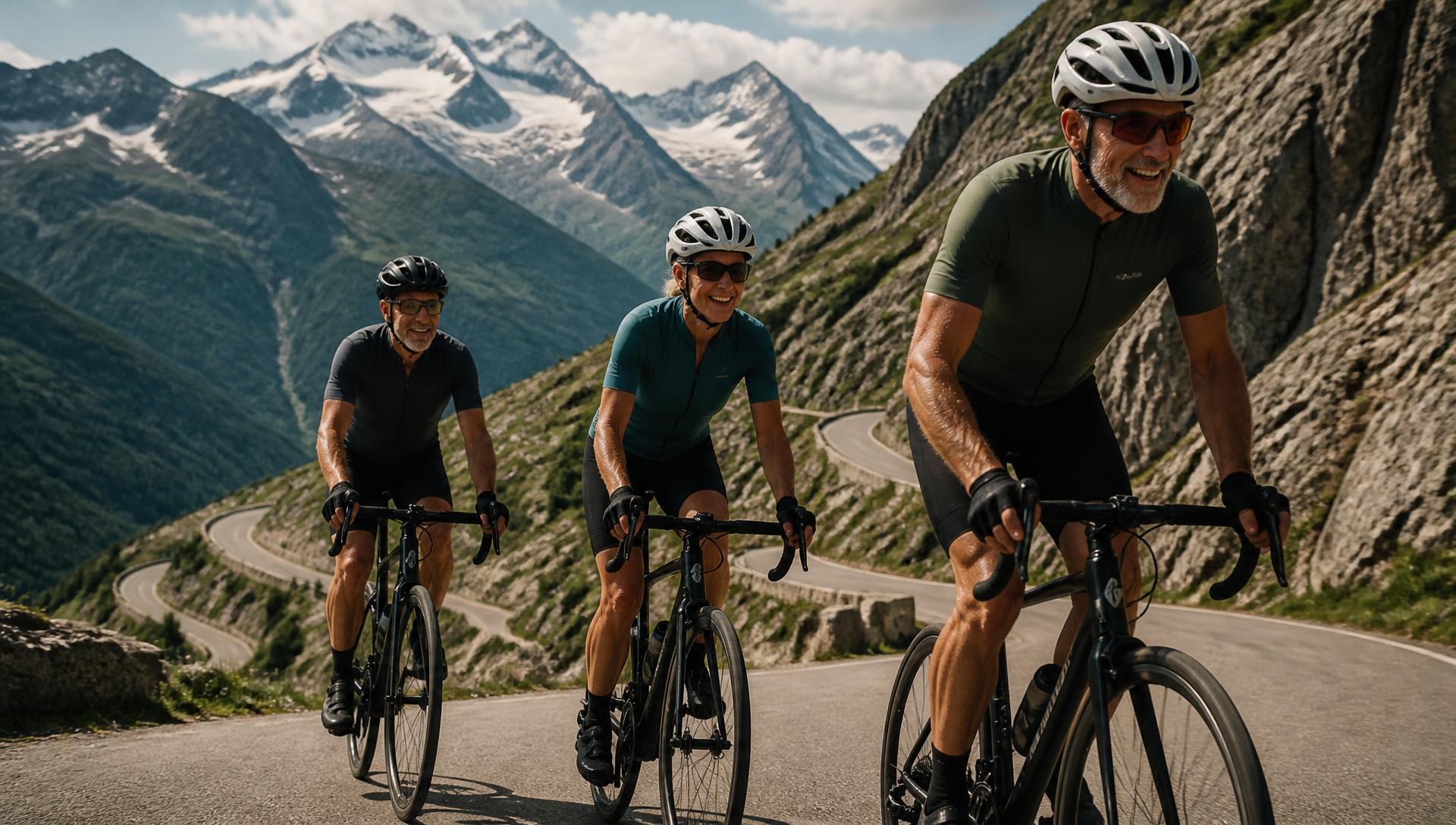
Maybe you’re not wondering whether you can handle a cycling holiday.
You’re wondering whether the cycling holiday can handle you.
You already ride regularly. You’re comfortable spending several hours in the saddle. Hills don’t scare you. And when you think about cycling in Europe, you’re probably looking beyond flat riverside paths and gentle introductory routes.
You want roads you’ll remember.
Climbs you’ve watched on television.
Descents that make you grin.
Great food afterward.
And a destination worth crossing the Atlantic for.
But here’s the important part:
Being capable of riding farther doesn’t mean you have to spend your vacation proving it.
A great cycling holiday for an experienced rider isn’t necessarily the one with the most kilometres, the steepest climbs or the biggest elevation numbers.
It’s the one that gives you the riding you came for and the European experience you travelled for.
Maybe that’s climbing famous Tour de France roads in the Alps.
Maybe it’s riding Sa Calobra in Mallorca.
Maybe it’s tackling the switchbacks of the Stelvio.
Maybe it’s bouncing across the cobbles of Flanders.
Or maybe it’s spending the morning riding through Tuscany and the afternoon sitting in a hill town wondering whether ordering another plate of pasta technically counts as recovery.
I think it does.
Because there’s a difference between a great place to ride and a great place to take a cycling holiday.
The best destinations give you both.
“The best place to ride isn’t always the best place to take a cycling holiday.”
Here are eight European road cycling experiences I’d put near the top of the list for an experienced cyclist looking for something more.
§ i
What Do We Mean by an Experienced Cyclist?
Let’s clear something up first.
Experienced doesn’t necessarily mean fast.
You don’t need racing credentials.
You don’t need a particular FTP.
You don’t need to average 30 kilometres per hour.
And you certainly don’t need to be the person attacking every hill on your Saturday morning group ride.
Experience is different from speed.
An experienced recreational cyclist may simply be someone who has ridden consistently for years and understands what several hours on a bicycle actually feels like.
You’re generally comfortable with things like:
- Riding several hours at a time
- Cycling on consecutive days
- Managing hills and longer climbs
- Descending confidently
- Shifting and braking effectively
- Eating and drinking while riding
- Pacing your effort
- Handling changing road and weather conditions
- Recognizing when you’re working too hard
- Understanding your own limits
What matters is that the bicycle already feels familiar.
You’re not learning how to become a cyclist while you’re on vacation.
You’re deciding where cycling can take you next.
§ ii
Compare Vertical Metres, Not Just Kilometres
When you’re comparing more challenging European cycling holidays, daily distance tells only part of the story.
Consider two rides.
80 kilometres with 400 metres of climbing.
And:
80 kilometres with 2,000 metres of climbing.
Same distance.
Completely different day.
Once mountains enter the picture, start paying close attention to:
- Total daily elevation
- Length of individual climbs
- Average gradients
- Steepest sections
- Altitude
- Technical descending
- Road surface
- Consecutive climbing days
- Recovery opportunities
A 65 kilometre Alpine stage could easily demand more from you than a considerably longer ride on flatter terrain.
And remember that you’re probably not riding one big day.
You’re riding again tomorrow.
Then perhaps again the next day.
That’s where itinerary design becomes important.
§ iii
1. Mallorca
Best Overall Road Cycling Holiday
If I had to choose one European destination that gives an experienced cyclist the best combination of serious riding and serious vacation, Mallorca would be very difficult to beat.
The Spanish island has become one of Europe’s great road cycling destinations for a reason.
You can ride long mountain climbs.
You can ride rolling inland roads.
You can head toward the coast.
You can have an easier recovery day.
And when you get off the bicycle, you’re still on a Mediterranean island.
That’s a pretty good combination.
The Serra de Tramuntana gives stronger riders the climbing they’re looking for, while routes elsewhere on the island provide considerably more variety.
And then there’s Sa Calobra.
The famous road twisting between the coast and the mountains has become one of Europe’s bucket-list cycling experiences, with its switchbacks, dramatic landscape and sustained climbing.
But Mallorca’s biggest strength may actually be that Sa Calobra doesn’t have to be your entire vacation.
You can have a hard mountain day followed by something more relaxed.
That’s valuable on a multi-day cycling holiday.
The Riding
Expect a mixture of:
- Sustained mountain climbing
- Rolling inland roads
- Coastal riding
- Technical descending
- Longer endurance days
- Easier recovery options
Mallorca gives you choices.
Why It’s Special
It has the cycling infrastructure and reputation of a serious riding destination without requiring your entire vacation to revolve around cycling.
There are bike shops.
Quality rental bikes.
Cyclist-friendly accommodation.
Restaurants.
Beaches.
Villages.
Mountain scenery.
Mediterranean coastline.
And plenty for someone travelling with you who doesn’t necessarily want to spend five hours on a bicycle.
Best For
The experienced cyclist who wants one of Europe’s best all-around combinations of road cycling, scenery, food, accommodation and vacation experience.
Watch Out For
Mallorca makes it very easy to turn every day into a big day.
Don’t.
If you smash yourself through the Tramuntana on Monday, Tuesday, Wednesday and Thursday, Mallorca isn’t responsible for what your legs think of you on Friday.
Build recovery into the holiday.
§ iv
2. Girona
Best for Cycling Culture
Mallorca feels like a fantastic vacation destination that happens to have extraordinary cycling.
Girona feels different.
Girona feels like a cycling town.
For years, professional cyclists and serious recreational riders have used this part of Catalonia as a base.
The appeal isn’t one famous road.
It’s the network.
Quiet secondary roads leave the city in multiple directions.
There are rolling routes.
Longer climbs.
Costa Brava riding.
Access toward the Pyrenees.
And famous local challenges such as Rocacorba.
Then you return to Girona itself.
Cycling cafés.
Bike shops.
Restaurants.
Historic streets.
A city centre where seeing another group of riders drinking espresso in cycling kit doesn’t seem unusual at all.
The Riding
Girona gives you tremendous variety.
One day can be rolling countryside.
Another can involve sustained climbing.
Another can take you toward the coast.
Another can become a serious mountain day.
That makes it particularly attractive for experienced cyclists because you can build a week around different kinds of riding rather than repeating the same experience every day.
Why It’s Special
Cycling isn’t something Girona added for tourists.
It’s part of the identity the city has developed.
That creates an atmosphere experienced cyclists tend to appreciate.
You’re surrounded by people who understand why someone would wake up early on vacation, put on cycling shoes and disappear for four hours.
Best For
Someone who wants to immerse themselves in European road cycling culture, not simply ride through beautiful scenery.
Watch Out For
Girona can encourage the same mistake as Mallorca.
Too much.
Too soon.
Too often.
When great roads begin close to where you’re staying, it’s tempting to make every day epic.
Remember:
You’re on a cycling holiday.
Not at training camp.
Unless, of course, training camp was the holiday you wanted.
§ v
3. French Alps
Best Tour de France Bucket-List Experience
There are cycling roads.
And then there are roads you’ve watched on television for years.
Alpe d’Huez.
Col du Galibier.
Col de la Croix de Fer.
Col du Télégraphe.
For many road cyclists, simply seeing those names is enough.
The French Alps offer something Mallorca and Girona can’t quite replicate:
Tour de France mythology.
You aren’t simply climbing a mountain.
You’re riding through cycling history.
You’ve seen professionals attack here.
Crack here.
Win here.
Lose the Tour here.
And now you’re riding the same road.
The Riding
This is where daily kilometres become almost meaningless without elevation.
A relatively short day can involve thousands of vertical metres.
Climbs can last for an hour or considerably longer.
Then you have to descend them.
And tomorrow there may be another one.
Mountain weather can also change quickly, which makes support and itinerary flexibility especially valuable.
Why It’s Special
The emotional experience.
You can ride a steep mountain road almost anywhere.
But you can’t recreate what it feels like to recognize the bends, see the names painted on the road and realize:
I’m actually riding this.
For someone who has followed professional cycling for years, that’s difficult to beat.
Best For
Experienced cyclists who have dreamed about riding the legendary roads of the Tour de France.
Watch Out For
Don’t underestimate cumulative fatigue.
One giant climb is one thing.
Several mountain days in succession are another.
This is where sensible gearing, recovery, pacing, nutrition and support matter enormously.
§ vi
4. Dolomites & Stelvio
Best for Spectacular Climbing
If the French Alps are about Tour de France mythology, the Dolomites and Stelvio are about sheer visual drama.
The roads seem engineered for cyclists with a weakness for switchbacks.
The mountains rise sharply.
The villages sit impossibly neatly beneath them.
And some of Europe’s most famous climbs are packed into this corner of northern Italy.
Stelvio.
Gavia.
Sella Ronda.
Passo Pordoi.
Passo Gardena.
The Stelvio from Prato gives you a sense of the scale: roughly 25 kilometres of climbing, around 1,800 metres of elevation gain and 48 hairpins before reaching the high mountain pass.
That is not a casual afternoon ride.
The Riding
Expect:
- Long mountain passes
- Sustained climbing
- High altitude
- Technical descending
- Repeated switchbacks
- Significant cumulative elevation
- Rapid weather changes
This is where compact gearing stops being an abstract equipment decision and starts becoming something you’ll appreciate deeply by kilometre 18 of a climb.
Why It’s Special
The scenery.
There are mountain roads all over Europe.
Very few look like the Dolomites.
The combination of dramatic rock formations, Alpine villages, Italian food and legendary cycling roads creates an experience that’s hard to replicate elsewhere.
Best For
The experienced cyclist who wants big mountain riding with extraordinary scenery.
Watch Out For
Altitude and weather.
A beautiful morning in the valley doesn’t guarantee the same conditions at the summit.
And after climbing for an hour or two, you still have to descend.
Confidence on long mountain descents matters here.
§ vii
5. Tuscany
Best for Cycling, Food and Culture
Tuscany is proof that an experienced cycling holiday doesn’t need to revolve around giant mountain passes.
The riding can still be demanding.
Rolling hills add up.
Short climbs repeat.
White gravel roads introduce another challenge.
And some routes are genuinely hard.
The full Brevetto Strade Bianche route, for example, is roughly 186 kilometres and includes around 63 kilometres of Tuscany’s famous white gravel roads.
But that’s not the point.
An experienced cyclist doesn’t need to ride all 186 kilometres to experience Tuscany properly.
The route can be divided into stages, turning a formidable challenge into a deeper travel experience.
That’s the difference between proving you can ride somewhere and giving yourself time to experience it.
The Riding
Depending on the itinerary:
- Rolling paved roads
- Longer gradual climbs
- Punchy hill-town ascents
- Gravel and Strade Bianche sections
- Low-traffic rural roads
- Road, all-road and gravel-bike options
Why It’s Special
You finish the ride in Tuscany.
That matters.
Siena.
Hill towns.
Wine.
Pasta.
Olive oil.
History.
Beautiful accommodation.
A terrace at sunset.
Experienced cyclists sometimes get so focused on the route that they forget they’re also travelling.
Tuscany makes that difficult.
Best For
Cyclists who want strong riding without sacrificing food, culture, scenery and the rest of the vacation.
Watch Out For
Rolling terrain can be deceptive.
A route without one giant climb can still accumulate a lot of elevation by the end of the day.
And if you’re riding gravel, surface quality and tyre choice matter.
§ viii
6. Pyrenees
Best Raw Mountain Challenge
The Pyrenees feel different from the Alps.
Less polished in places.
Quieter.
More remote.
More focused on the mountains themselves.
This is classic Tour de France territory:
Col du Tourmalet.
Col d’Aubisque.
Col de Peyresourde.
Col d’Aspin.
These are not novelty climbs.
They are long, sustained efforts.
The Riding
Expect:
- Long mountain passes
- Significant elevation
- Repeated climbing days
- Remote roads
- Descending
- Variable mountain weather
- Less opportunity to fake fitness
The Pyrenees reward pacing.
Go too hard early and the mountain will remind you that it isn’t impressed.
Why It’s Special
The feeling of being in the mountains.
Not simply passing through them.
For some experienced cyclists, that is exactly the point.
Best For
Someone who says:
“The climbing is why I’m going.”
Watch Out For
This is cycling-first travel.
If your partner isn’t riding, or if you want a broader resort-style vacation, there may be better choices.
And consecutive mountain days require respect.
§ ix
7. Flanders
Best for Cycling History and the Classics
Experienced road cycling in Europe does not have to mean mountains.
Flanders proves it.
The climbs may be short.
But some are brutally steep.
The roads may not rise for 20 kilometres.
But they may be cobbled.
And the wind may decide to join the conversation.
This is the world of:
Koppenberg.
Oude Kwaremont.
Paterberg.
Muur van Geraardsbergen.
The Riding
Expect:
- Short steep climbs
- Cobblestones
- Wind
- Repeated accelerations
- Rolling roads
- Technical bike handling
- Constant changes of rhythm
Mountains aren’t the only way Europe can hurt your legs.
Why It’s Special
Cycling history is everywhere.
You can ride roads you’ve seen in the Spring Classics.
You can visit Bruges or Ghent.
You can drink Belgian beer afterward and debate whether cobbles are character-building or simply cruel.
And if you build your trip around Tour of Flanders weekend, you can combine riding the famous roads with experiencing the professional race.
Best For
Classics fans and experienced riders who want cycling culture, history and a different kind of challenge.
Watch Out For
Cobbles demand bike handling as well as fitness.
Short, extremely steep bergs can also make gearing, traction and momentum surprisingly important.
§ x
8. Tenerife
Best Winter Climbing Escape for Strong Riders
For Canadian cyclists, Tenerife deserves special attention for one simple reason:
Winter.
When riding at home means layers, trainers or indoor training, Tenerife offers the possibility of serious climbing in a comparatively mild winter climate.
And the riding is not gentle.
Mount Teide dominates the island’s cycling identity.
Long climbs.
Altitude.
Extended efforts.
Professional riders regularly use the island for training.
One of Tenerife’s major road routes covers more than 160 kilometres, accumulates close to 4,000 metres of climbing and reaches well above 2,000 metres.
The Riding
Expect:
- Long sustained climbing
- Significant elevation
- Altitude
- Open volcanic landscapes
- Long descents
- Routes where distance understates difficulty
A 70 kilometre day can contain an enormous amount of climbing.
Why It’s Special
It’s an escape.
You can leave winter behind and get serious climbing without waiting for summer in the Alps or Dolomites.
The volcanic scenery also gives the island a completely different visual character from the rest of this list.
Best For
Strong riders looking for a winter or early-season climbing destination.
Watch Out For
The climbs are long.
Very long.
If your idea of winter training is “a few easy rides somewhere warm,” Tenerife may have other plans for you.
§ xi
How the Eight Compare
- Mallorca
- Riding characterVaried roads + long climbsDemandHighBest forBest overall
- Girona
- Riding characterRolling + sustained climbingDemandHighBest forCycling culture
- French Alps
- Riding characterLong mountain passesDemandVery highBest forTour legends
- Dolomites & Stelvio
- Riding characterSteep mountain passesDemandVery highBest forSpectacular climbing
- Tuscany
- Riding characterRolling + gravel optionsDemandModerate-highBest forCycling + culture
- Pyrenees
- Riding characterLong mountain passesDemandVery highBest forRaw mountain challenge
- Flanders
- Riding characterCobbles + short steep bergsDemandHighBest forClassics/history
- Tenerife
- Riding characterSustained climbing + altitudeDemandVery highBest forWinter escape
| Destination | Riding character | Demand | Best for |
|---|---|---|---|
| Mallorca | Varied roads + long climbs | High | Best overall |
| Girona | Rolling + sustained climbing | High | Cycling culture |
| French Alps | Long mountain passes | Very high | Tour legends |
| Dolomites & Stelvio | Steep mountain passes | Very high | Spectacular climbing |
| Tuscany | Rolling + gravel options | Moderate-high | Cycling + culture |
| Pyrenees | Long mountain passes | Very high | Raw mountain challenge |
| Flanders | Cobbles + short steep bergs | High | Classics/history |
| Tenerife | Sustained climbing + altitude | Very high | Winter escape |
These are PEDAL & PORT editorial comparisons rather than standardized tour grades. Actual difficulty varies considerably by itinerary, distance, elevation, weather and route choice.
Don’t choose based on difficulty alone.
Choose based on the kind of cycling experience you want.
If you’re capable of climbing 2,000 metres in a day, that doesn’t mean every vacation should include 2,000 metres every day.
The Cycling Holiday Playbook
Planning a Cycling Holiday?
34 pages. 22 chapters. 3 PEDAL & PORT planning tools.
Get the Free Playbook§ xii
What Bike Should You Ride?
Experienced cyclists tend to care much more about the bike than first-time cycling travellers.
And they should.
A week of mountain riding on the wrong gearing or a poor-fitting rental bike can become a very expensive lesson.
Before booking, find out exactly what is available.
Not simply:
“Premium road bike included.”
Ask:
- What make and model?
- What frame sizes?
- Mechanical or electronic shifting?
- What gearing?
- Disc or rim brakes?
- What tyres?
- What pedals?
- Can I bring my own saddle?
- Can I bring my own pedals?
- Are e-road bikes available?
Performance Road Bike
The natural choice for most paved-road itineraries in Mallorca, Girona, the Alps, Dolomites, Pyrenees and Tenerife.
All-Road or Gravel Bike
Potentially ideal for Tuscany if your itinerary includes Strade Bianche-style roads.
E-Road Bike
This is worth considering even if you’re a strong cyclist.
Maybe you’re perfectly capable of completing every climb.
But an e-road bike could allow you to enjoy five consecutive mountain days rather than survive the final two.
An e-road bike can be a trip-design choice, not a statement about ability.
§ xiii
Bring Your Own Bike or Rent in Europe?
This is one of those questions experienced cyclists can argue about for hours.
Both options make sense.
Bring Your Own Bike
Advantages:
- Perfect fit
- Familiar saddle
- Familiar pedals
- Known gearing
- Familiar handling
- No adaptation period
Disadvantages:
- Bike box
- Airline fees
- Airport logistics
- Transfer headaches
- Damage risk
- Somewhere to store the case
Rent in Europe
Advantages:
- Easier travel days
- No bike case
- Simpler transfers
- Potential access to excellent equipment
- Easier e-road-bike option
Disadvantages:
- Fit must be right
- Saddle may differ
- Gearing may not match your preference
- Model availability can vary
- You need to confirm the specification
For a mountain trip, I would never assume.
Get the exact bike details before booking — and factor them into the complete cost of the trip.
§ xiv
Guided or Self-Guided for Experienced Cyclists?
Being an experienced cyclist doesn’t automatically make self-guided the better choice.
In fact, the harder the terrain, the more valuable good support can become.
A guide or supported tour may provide:
- Local route knowledge
- Weather decisions
- Mechanical assistance
- Support vehicles
- Water and nutrition
- Alternate route options
- Transfers
- Help if a mountain road closes
- Local knowledge you would otherwise miss
You may not need someone to show you how to ride.
That’s not the point.
You’re paying for expertise and logistics.
If you’re deciding how much support you want, our guide to Guided vs. Self-Guided Cycling Holidays in Europe goes deeper into the differences.
§ xv
Ride the Roads or Experience the Event?
There’s another way to build an experienced cycling holiday.
Don’t simply visit a famous cycling destination.
Go when cycling history is happening.
Flanders
Build the trip around Tour of Flanders weekend and combine riding the famous roads with watching the professional race.
Tuscany
Build the trip around Strade Bianche, ride the famous white roads and experience the professional race in Siena.
French Alps
Ride legendary Tour de France climbs and combine the trip with experiencing a mountain stage of the Tour.
Dolomites
Build the trip around a major cycling event or famous mountain challenge.
The difference is significant.
A normal cycling holiday lets you ride legendary roads.
An event-based trip lets you feel part of the culture surrounding them.
For the right cyclist, that can turn a great trip into a lifetime memory.
§ xvi
Travelling With Someone Who Doesn’t Ride at Your Level?
This is more common than cyclists like to admit.
You want:
100 kilometres and 2,000 metres of climbing.
Your partner wants:
50 kilometres and lunch.
Neither person is wrong.
The right trip can accommodate both.
Look for:
- Multiple route lengths
- E-road-bike options
- Support vehicles
- Optional riding days
- Great hotels
- Walkable towns
- Food and wine experiences
- Beaches
- Cultural activities
- Things worth doing when you’re not cycling
For mixed-ability couples, I would look particularly closely at:
Mallorca.
Tuscany.
Girona.
Flanders.
Those destinations offer enough beyond cycling that both people can have a great vacation.
§ xvii
Don’t Turn Your Holiday Into a Training Camp
Experienced cyclists can be terrible at this.
A beautiful route appears.
We add it.
Another climb is nearby.
We add that too.
There’s an extra 30 kilometre option.
Obviously we take it.
Before long, the “vacation” has become a seven-day stage race with nicer hotels.
You flew to Europe.
Stop for the espresso.
Eat the lunch.
Walk through the village.
Take the photograph.
Have the wine.
Sit on the terrace.
You’re allowed to enjoy yourself.
Being capable of riding farther doesn’t mean you have to spend your vacation proving it.
You already know you can ride.
Now let the bicycle help you experience the place.
§ xviii
If You Asked Me Where to Go…
Here’s how I’d narrow the eight down.
Choose Mallorca
If you want the best all-around road cycling holiday.
Choose Girona
If you want to immerse yourself in cycling culture.
Choose the French Alps
If riding legendary Tour de France roads is the dream.
Choose the Dolomites & Stelvio
If you want the most spectacular mountain climbing.
Choose Tuscany
If great riding matters, but food, culture and the rest of the vacation matter just as much.
Choose the Pyrenees
If the mountain challenge itself is why you’re travelling.
Choose Flanders
If you love cycling history, cobbles and the Spring Classics.
Choose Tenerife
If you want a winter climbing escape.
There isn’t one best European road cycling destination.
There is a best destination for the cyclist and traveller you are.
§
Before You Book: 12 Questions to Ask
- 1How much elevation will I climb each day?
- 2What are the longest climbs?
- 3What gradients should I expect?
- 4How technical are the descents?
- 5What exact bike models are available?
- 6What gearing is provided?
- 7Are e-road bikes available?
- 8Are multiple route lengths offered?
- 9Is there vehicle support?
- 10What happens if weather changes the planned mountain route?
- 11What options exist for a partner who isn’t riding?
- 12What is included in the complete trip price?
Want to compare destinations, trip styles, fitness, bike options and costs in one place? Start with the PEDAL & PORT Cycling Holiday Guide.
§
Frequently Asked Questions
What is the best road cycling destination in Europe?
There isn’t one answer for every experienced cyclist.
Mallorca is probably the strongest all-around choice because it combines serious riding, excellent cycling infrastructure, route variety and a complete Mediterranean vacation.
Girona may be better if cycling culture is your priority, while the Alps, Dolomites and Pyrenees are stronger choices if mountain climbing is the reason you’re travelling.
Is Mallorca or Girona better for road cycling?
Mallorca is particularly strong for route variety, iconic climbs and the broader vacation experience.
Girona is especially attractive for cycling culture, quiet roads, climbing access and the feeling of being based in a true cycling town.
The better choice depends on whether you want the most complete cycling vacation or the deeper cycling-culture experience.
What are the best European cycling destinations for climbing?
The French Alps, Dolomites, Pyrenees and Tenerife should all be high on the list.
Mallorca also offers excellent mountain riding while providing more route variety and recovery-day options.
How fit do I need to be to cycle the French Alps?
You should be comfortable with sustained climbing, significant daily elevation and riding on consecutive days.
The exact fitness requirement depends on the itinerary, gearing, route options and whether support is available.
If you’re unsure where you stand, our guide to How Fit Do You Need to Be for a Cycling Holiday in Europe? is a useful starting point.
Are the Dolomites harder than the French Alps?
Not universally.
Both can be extremely demanding.
Difficulty depends on the specific climbs, gradients, daily elevation, altitude and itinerary structure.
The Dolomites often combine steep gradients with high-altitude riding, while the French Alps offer many very long Tour de France-style passes.
Is Tuscany good for experienced road cyclists?
Absolutely.
Tuscany offers demanding rolling roads, longer climbs, low-traffic routes and opportunities to ride famous white-gravel roads associated with Strade Bianche.
It also provides one of the strongest combinations of serious cycling, food, wine and culture.
Should I bring my own bike to Europe or rent one?
Both can work.
Bringing your own bicycle gives you perfect familiarity and fit.
Renting simplifies flights and transfers and can provide access to high-quality road or e-road bikes.
If renting, confirm the exact model, size, gearing, brakes, pedals and fit before travelling.
Can experienced cyclists use e-road bikes on cycling holidays?
Yes.
An e-road bike can help manage long climbing days, consecutive mountain stages or differences in riding ability between travelling companions.
Using electric assistance doesn’t make someone less experienced.
It’s another way to design the holiday.
If you’re weighing electric assistance against a conventional bike, see E-Bike or Regular Bike for a Cycling Holiday in Europe?
What is the best winter road cycling destination in Europe?
Tenerife is one of the strongest options for experienced cyclists looking for sustained climbing and comparatively mild winter riding.
Mallorca can also be attractive outside peak summer, depending on conditions and the type of trip.
Can couples with different cycling abilities enjoy the same cycling holiday?
Absolutely, provided the trip is designed for it.
Look for multiple route options, e-road bikes, support vehicles, optional riding days and destinations with strong non-cycling experiences.
Mallorca, Tuscany, Girona and Flanders can all work particularly well.