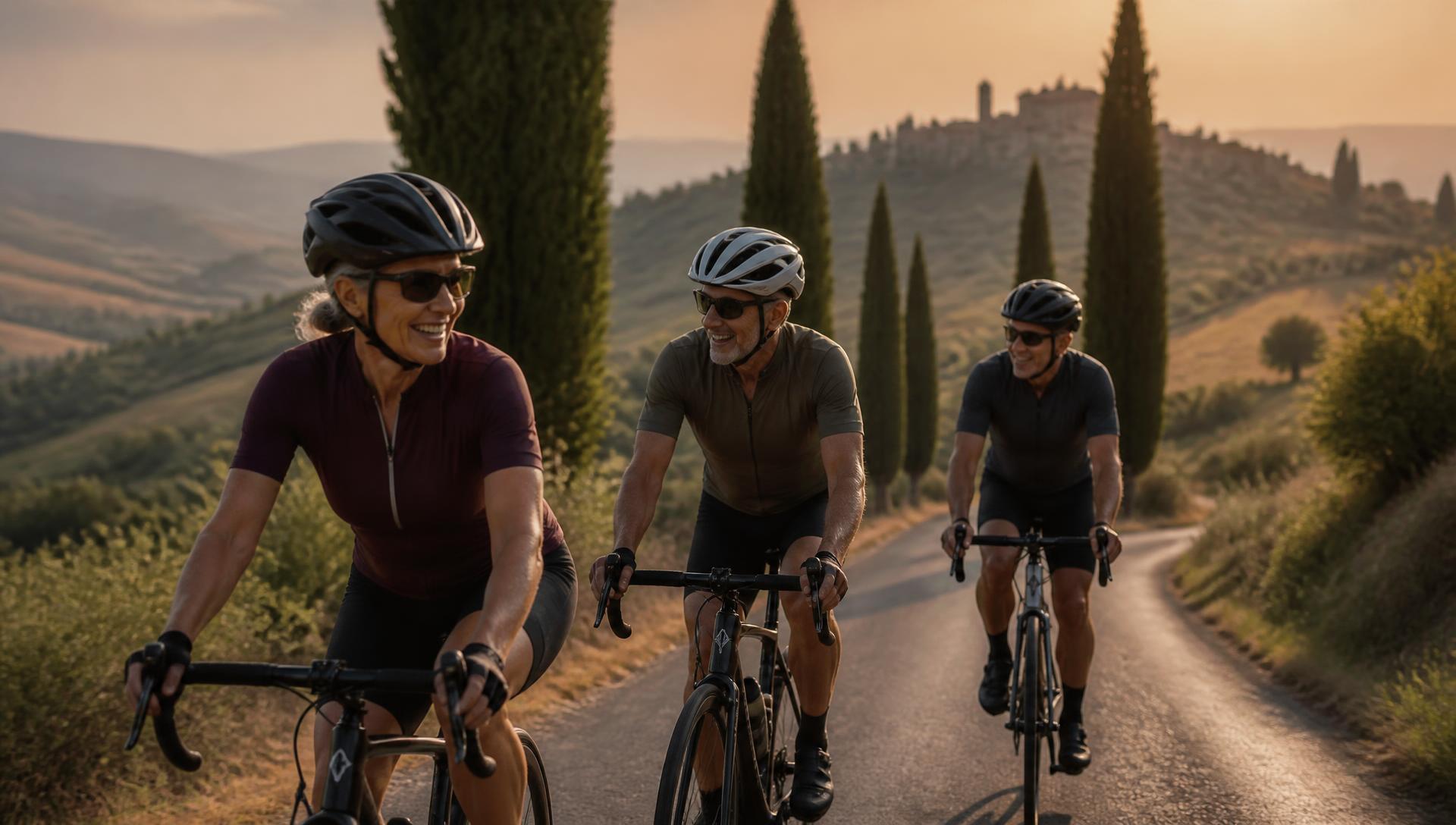
If you’re thinking about a cycling holiday in Europe after 50, the most important question isn’t your age.
It’s whether the trip fits the cyclist you are today and the kind of vacation you actually want.
I’m 61, and one thing cycling has taught me is that the number on your birthday tells me very little about the cyclist beside me. I’ve ridden with people younger than me who are happiest with a relaxed 30-kilometre ride and people older than me who are ready to keep going.
That’s why I wouldn’t choose a cycling holiday simply because it’s marketed to travellers over 50.
I’d look at five things instead: how you ride now, the distance you comfortably enjoy, how you feel about climbing, how well you recover from consecutive riding days, and how important cycling is to the overall vacation.
Get those right and Europe opens up an incredible range of possibilities.
§ i
Is 50, 60 or 70 Too Old for a Cycling Holiday?
No. Age by itself isn’t a useful way to determine whether someone is ready for a cycling holiday.
Cycling can remain an excellent form of physical activity as we get older, and the growth of e-bikes has made cycling travel accessible to an even wider range of riders.
But that doesn’t mean every cycling holiday is right for every cyclist.
A flat 40-kilometre ride along a European river is very different from 80 kilometres through the Dolomites. A Bike & Boat holiday is different from a road cycling trip based in Girona. And riding comfortably one day isn’t necessarily the same as enjoying five consecutive days in the saddle.
The better question is:
What kind of cycling holiday is right for me?
§ ii
Don't Choose Your Cycling Holiday by Age. Start With These Five Things.
1. How are you riding now?
Start with what you’re actually doing today, not what you did ten years ago or what you hope you’ll be able to do by departure day.
Do you ride once a week?
Three or four times a week?
Are most of your rides 25 kilometres or 75?
Do you ride mainly recreationally, train regularly or participate in group rides?
Your current riding gives you a much better starting point than your age. It is also the honest place to begin when asking how fit you need to be for a cycling holiday in Europe.
2. What’s your comfortable day?
There is a difference between the distance you can ride and the distance you genuinely enjoy riding.
That’s important on vacation.
If 40 to 50 kilometres leaves you feeling great and ready to explore a town, enjoy dinner and ride again tomorrow, that may be a much better holiday distance than pushing yourself through 80 kilometres simply because you’re capable of doing it.
A cycling holiday isn’t a fitness test.
For most of us, the goal is to finish the day thinking:
I’d happily do that again tomorrow.
3. How comfortable are you with climbing?
Distance doesn’t tell the whole story.
A relatively flat 60-kilometre day beside the Danube can feel completely different from 60 kilometres with long or steep climbs.
When comparing cycling holidays, look beyond the daily kilometres and ask about:
- total elevation
- length and steepness of climbs
- road or trail surface
- technical difficulty
- available e-bike options
- support if you decide not to complete the entire route
This is one of the easiest ways to avoid choosing a trip that looks perfect on paper but doesn’t feel perfect on the bike.
4. How well do you recover?
This is one of the most overlooked questions in cycling travel.
You might comfortably ride 70 kilometres on Saturday.
But how would you feel about doing another 60 kilometres Sunday?
And again Monday?
Multi-day cycling holidays aren’t only about your ability to complete one ride. They’re about enjoying consecutive days of riding.
Recovery, sleep, nutrition, hydration and appropriate pacing become part of the experience.
A slightly easier daily itinerary can sometimes produce a much better vacation.
5. Do you want cycling to be the vacation or part of the vacation?
This may be the most important question of all.
Some travellers want to wake up thinking about the ride ahead. They want challenging routes, famous climbs and long days on the bike.
For them, cycling is the vacation.
Others love cycling but also want cafés, sightseeing, local food, wine, history, walking through towns and time to relax.
For them, cycling is part of the vacation.
Neither is better.
But they can lead you toward very different trips.
A dedicated road cycling holiday, self-guided cycling tour, Bike & Boat experience and active river cruise can all involve a bicycle while delivering completely different vacations.
§ iii
What Type of Cyclist Are You?
Instead of defining yourself by age, think about which description sounds most like you.
The Active Traveller
You stay fit and enjoy being active, but cycling isn’t necessarily your main activity.
You might enjoy shorter distances, flatter terrain, an e-bike and plenty of time to experience the destination.
The Recreational Cyclist
You ride regularly for fitness, enjoyment and social connection.
You’re comfortable spending a few hours on the bike and want cycling to be an important part of the trip without necessarily turning every day into a major challenge.
This can be a great fit for many European self-guided cycling holidays and Bike & Boat experiences — and for the European routes that suit first-time cycling travellers.
The Returning Cyclist
You’ve cycled before but haven’t been riding consistently.
You don’t need to start from zero, but choosing manageable daily distances and allowing enough preparation time can make the difference between enduring the trip and enjoying it.
An e-bike can also expand your options considerably.
The Experienced Cyclist
You ride frequently and may actively seek longer distances, significant climbing or famous European road cycling destinations.
Mallorca, Girona, the Alps, Dolomites, Tuscany and the Pyrenees might be exactly what you’re looking for.
Being over 50 doesn’t automatically mean you should choose an easier trip.
Choose the trip that matches the cyclist you actually are.
- Active traveller
- Consider starting with…Active river cruise or relaxed cycling tourLook closely at…Shorter rides, flexibility, sightseeing time
- Recreational cyclist
- Consider starting with…Self-guided tour or Bike & BoatLook closely at…Daily distance, elevation, consecutive days
- Returning cyclist
- Consider starting with…Supported tour with e-bike optionLook closely at…Terrain, recovery, support and route flexibility
- Experienced cyclist
- Consider starting with…Road cycling holiday or challenging self-guided tourLook closely at…Climbing, distance, road quality and iconic routes
| You sound like… | Consider starting with… | Look closely at… |
|---|---|---|
| Active traveller | Active river cruise or relaxed cycling tour | Shorter rides, flexibility, sightseeing time |
| Recreational cyclist | Self-guided tour or Bike & Boat | Daily distance, elevation, consecutive days |
| Returning cyclist | Supported tour with e-bike option | Terrain, recovery, support and route flexibility |
| Experienced cyclist | Road cycling holiday or challenging self-guided tour | Climbing, distance, road quality and iconic routes |
§ iv
How Far Should You Cycle Each Day?
There isn’t one correct number.
A better starting point is your normal comfortable riding distance.
If you regularly enjoy 40-kilometre rides at home, a vacation requiring 80 kilometres every day probably deserves careful consideration.
Likewise, someone who routinely rides 70 to 100 kilometres may find a flat 25-kilometre itinerary less satisfying if cycling is supposed to be the main attraction.
Also remember that vacation kilometres are different.
You’ll stop for photographs.
You’ll explore towns.
You’ll have lunch.
You may encounter unfamiliar roads, surfaces, weather and navigation.
The objective isn’t necessarily to cover the greatest distance.
It’s to have a great day.
“Start with the cyclist you are today, not the year on your birth certificate.”
§ v
Should You Choose an E-Bike After 50?
Maybe. But not simply because you’re over 50.
An e-bike can be a smart choice if it helps you:
- manage hills more comfortably
- ride with a stronger partner or group
- enjoy consecutive cycling days
- extend your comfortable range
- recover more easily
- spend less of your vacation worrying about whether you can finish the route
Research suggests e-bike riding can still provide meaningful physical activity while reducing some of the effort required compared with a conventional bicycle.
Think of the motor as assistance, not replacement.
For the right traveller, an e-bike doesn’t diminish the cycling holiday.
It can make the right cycling holiday possible.
If you’re weighing it up, I compared the two in more detail in e-bike or regular bike for a cycling holiday in Europe.
§ vi
Guided or Self-Guided?
This depends more on your travel personality than your age.
A guided cycling holiday may suit you if you value a ride leader, group atmosphere, built-in support and having most decisions handled for you.
A self-guided cycling holiday may suit you if you prefer flexibility, independence and moving through the day at your own pace while the operator handles major logistics such as accommodation and luggage transfers.
Experienced travellers may love self-guided freedom.
First-time cycling travellers may appreciate guided support.
And plenty of people fall somewhere in between. I set the two side by side in guided versus self-guided cycling holidays.
§ vii
What If Your Partner Rides at a Different Level?
This is common and it doesn’t mean you need separate vacations.
An e-bike can help close the difference between riders.
Some routes offer optional distances or route variations.
Bike & Boat holidays can provide opportunities for one partner to ride while another relaxes or explores independently.
Active river cruises may allow cycling to be one activity among several rather than the centre of every day.
The goal isn’t necessarily to make both people ride identically.
It’s to find an experience where both people can enjoy the same vacation. I wrote a whole piece about travelling with a partner who doesn’t cycle as much as you do.
§ viii
Which Kind of European Cycling Holiday Might Suit You?
Self-guided cycling tour
Good for travellers who want independence while having accommodation, route planning and often luggage transfers organized.
Guided cycling tour
Good for travellers who enjoy group riding, leadership and additional support.
Bike & Boat
Your accommodation travels with you while cycling routes explore the surrounding region. It can be an appealing combination of activity, scenery and social travel — the idea behind our Bike & River journeys.
Active river cruise
Cycling may be one activity alongside walking, hiking, kayaking, sightseeing and traditional excursions.
This can work particularly well when one person loves cycling and another wants more variety.
Road cycling holiday
Best suited to cyclists who want the riding itself to be a major part of the trip, potentially including longer distances, challenging climbs and iconic cycling destinations.
Timing matters here too — where you ride in April is rarely where you would ride in August, which is why I put together a guide to cycling Europe by region and season.
§ ix
How Should You Prepare for a Cycling Holiday After 50?
The best preparation is consistency.
You don’t necessarily need to train like you’re entering a race.
You do want your body to become comfortable with the type of riding you’ll experience on the trip.
As departure approaches, gradually build toward:
- your expected daily distance
- similar terrain when possible
- some consecutive riding days
- time in the saddle
- the clothing and equipment you'll use
- comfortable hydration and nutrition habits
If you’re significantly increasing your activity level or have health concerns that could affect exercise or travel, it’s sensible to discuss your plans with an appropriate healthcare professional.
It’s also worth reading what to know before booking a first cycling holiday in Europe and understanding what a European cycling holiday actually costs.
§ x
Questions to Ask Before Booking
Before choosing a cycling holiday, ask:
- How far will I ride each day?
- How much climbing is involved?
- What surfaces will I ride on?
- Are e-bikes available?
- What happens if I don’t want to ride one day?
- Is luggage transferred?
- What support is available during the ride?
- Is the trip guided or self-guided?
- How much non-cycling time is built into the itinerary?
- What kind of cyclist usually enjoys this trip most?
That last question may tell you more than the age range in the brochure.
The Cycling Holiday Playbook
Planning a Cycling Holiday?
34 pages. 22 chapters. 3 PEDAL & PORT planning tools.
Get the Free Playbook§ xi
A Note on Cycling and Staying Active
Research supports cycling as a form of physical activity that can remain appropriate as people get older. Research on e-bikes also suggests pedal assistance can reduce physical demand while still providing meaningful activity and helping more people participate in cycling.
The important distinction for travel is that population research cannot tell you which specific cycling holiday is right for you. Your current ability, health, experience and the demands of the itinerary still matter.
§ xii
The Right Cycling Holiday Isn't Determined by Your Age
Europe offers cycling experiences for an enormous range of riders.
You don’t have to prove anything.
You don’t have to choose an e-bike because of your age.
And you don’t have to choose an easy cycling holiday simply because someone has labelled you an older traveller.
Start with the cyclist you are today.
Think about how you like to travel.
Then find the experience where those two things come together.
That’s where a cycling trip becomes a great vacation.
§
Frequently Asked Questions
Am I too old for a cycling holiday at 60?
Age alone doesn't determine whether you're suited to a cycling holiday. Current fitness, riding experience, comfortable distance, terrain, recovery and the demands of the particular itinerary are much more useful considerations.
Are cycling holidays suitable for people over 50?
Yes. European cycling holidays range from relaxed recreational routes to demanding road cycling trips. The key is choosing an itinerary that matches your current ability and travel preferences.
Do I need an e-bike for a cycling holiday after 50?
Not necessarily. Choose an e-bike based on terrain, distance, fitness, recovery, riding companions and personal preference rather than age alone.
How far should I cycle each day on a cycling holiday?
There is no universal distance. Choose daily distances that you can comfortably enjoy on consecutive days while still having energy for the rest of your vacation.
Can couples with different cycling abilities take a cycling holiday together?
Yes. E-bikes, flexible routes, optional riding days, Bike & Boat holidays and active river cruises can all help couples with different riding abilities enjoy the same vacation.
Is guided or self-guided better after 50?
Neither is inherently better based on age. Guided trips provide leadership, group companionship and additional support. Self-guided trips provide greater independence and flexibility.
How far in advance should I prepare?
That depends on your starting fitness and the difficulty of the trip. Rather than focusing on a fixed number of weeks, aim to become comfortable with similar distances, terrain and consecutive riding days well before departure.
§
Keep Exploring
If a European cycling holiday is on your radar, the PEDAL & PORT Cycling Holiday Playbook walks through the decisions that matter, from fitness and trip difficulty to e-bikes, costs, logistics and choosing the right travel style.
You can also browse everything we’ve written about cycling holidays in Europe.
And if you’re trying to figure out which kind of cycling experience fits you, that’s exactly the kind of conversation PEDAL & PORT is here to help with.