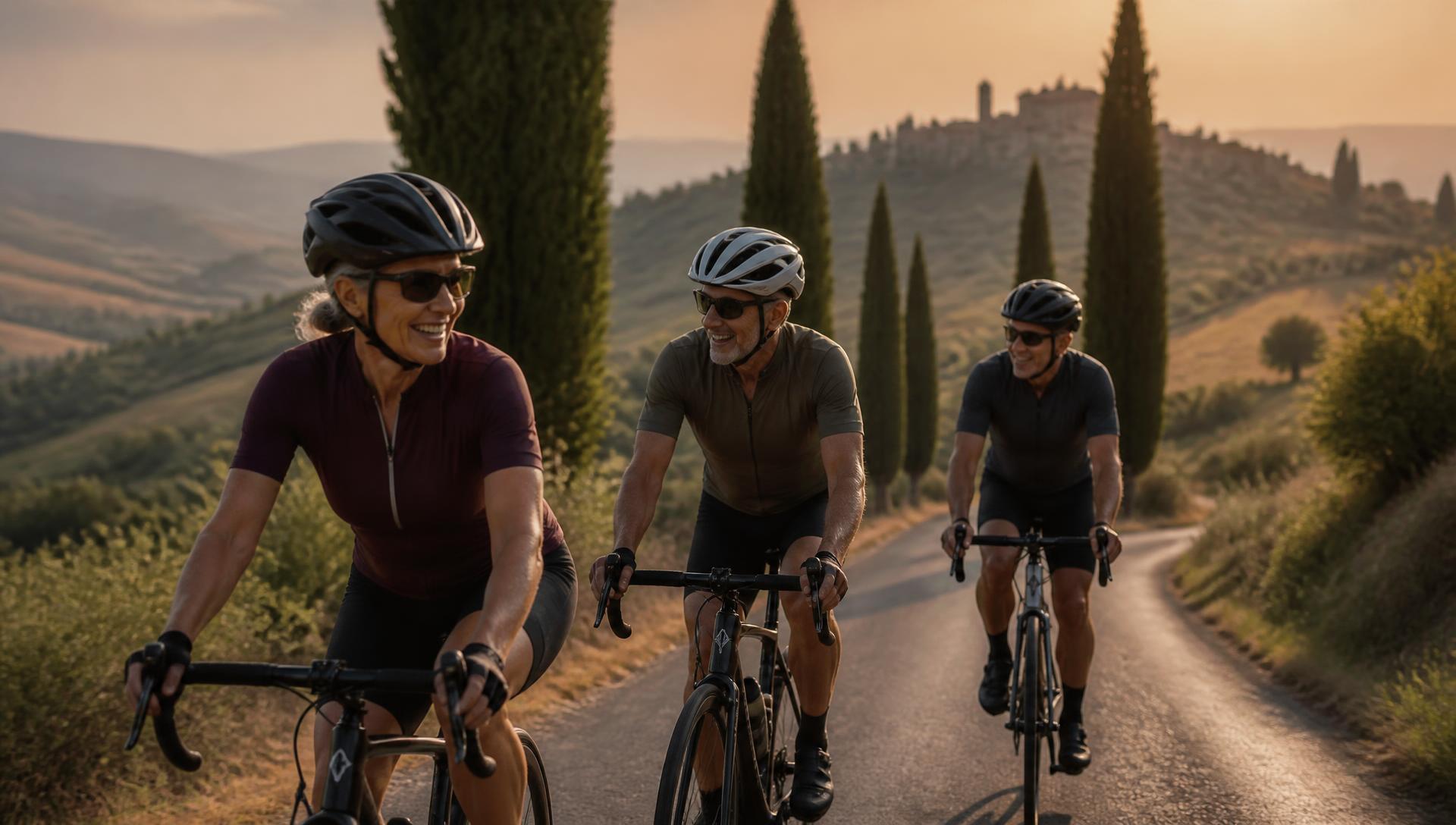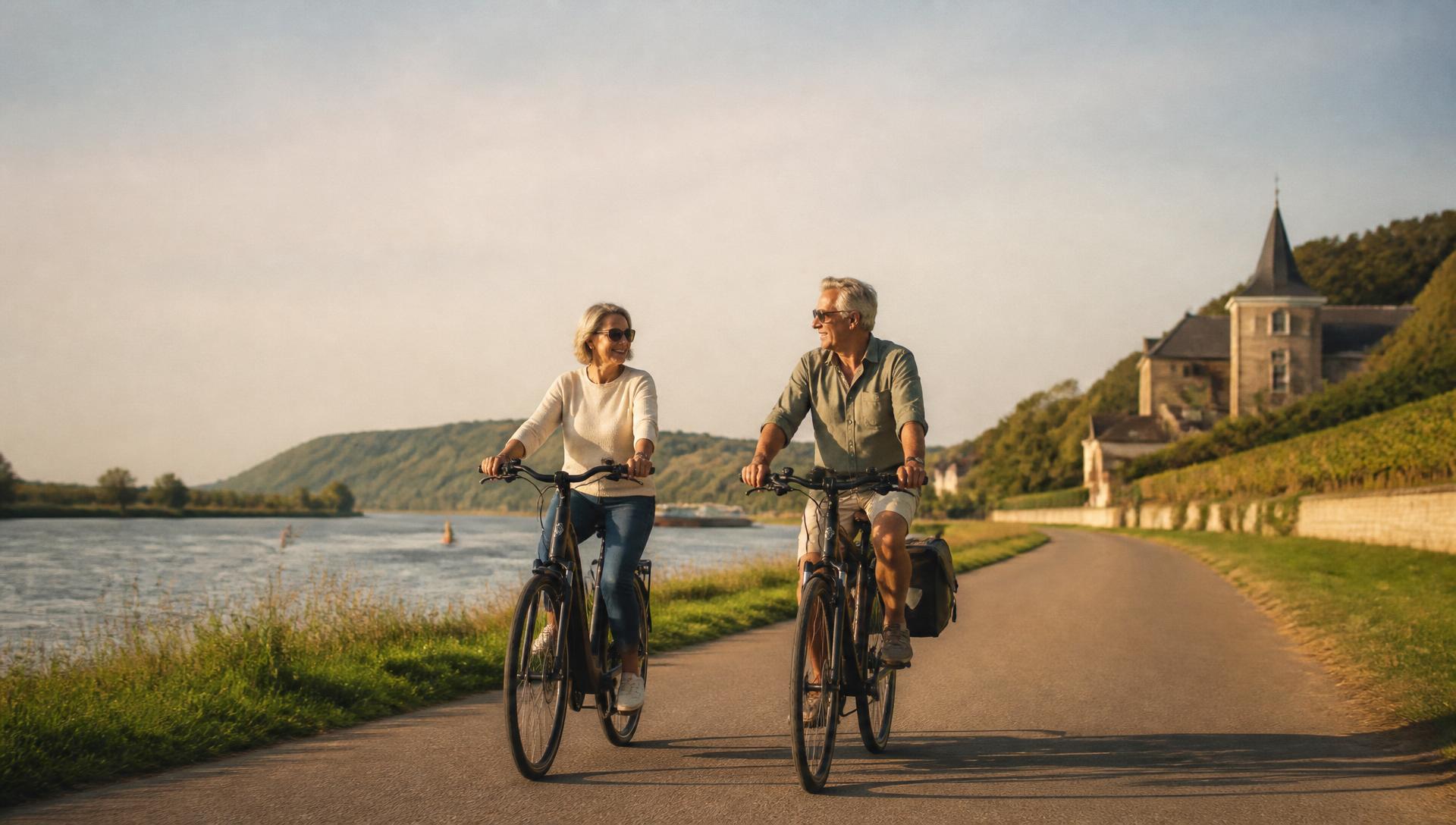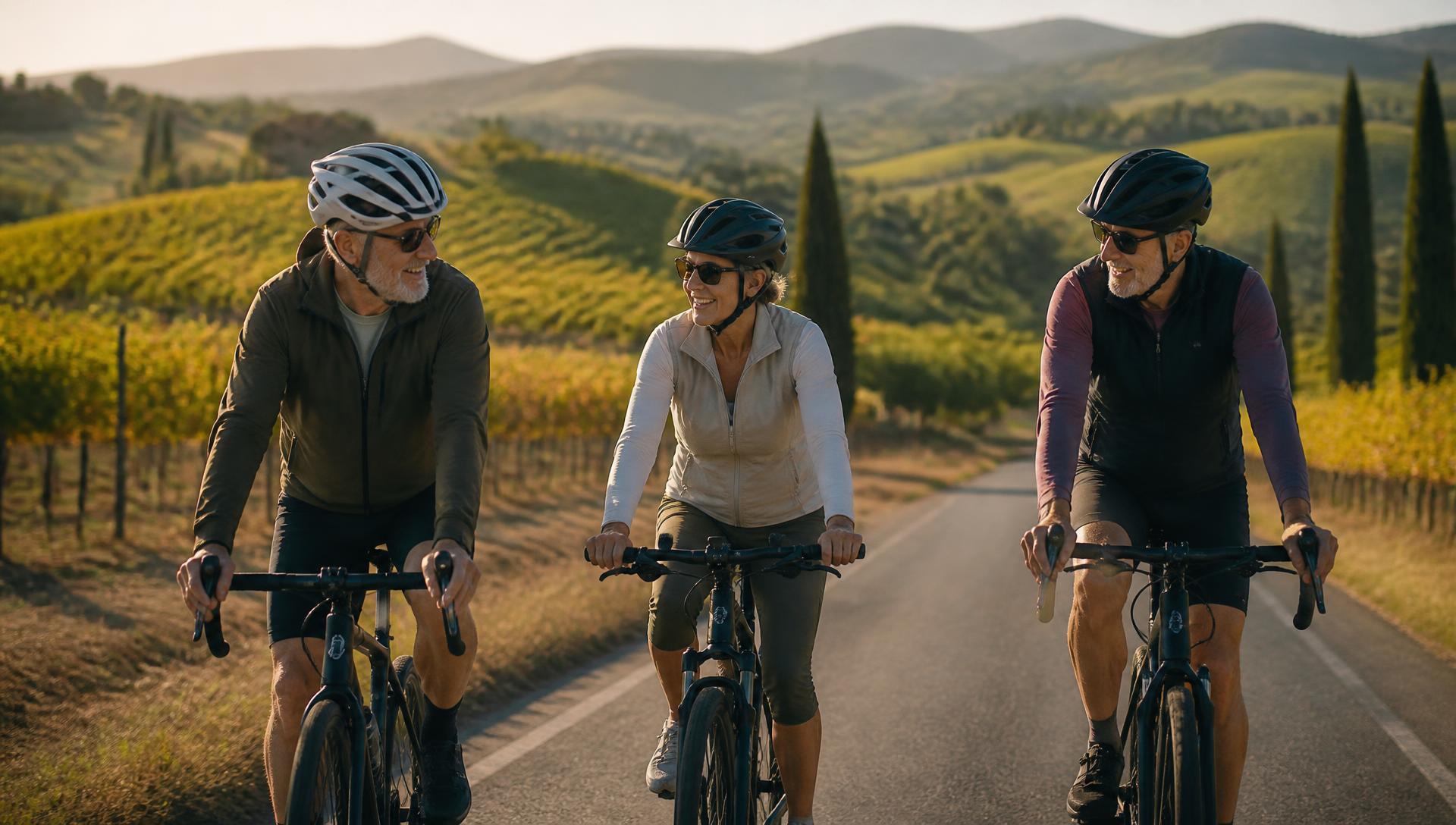
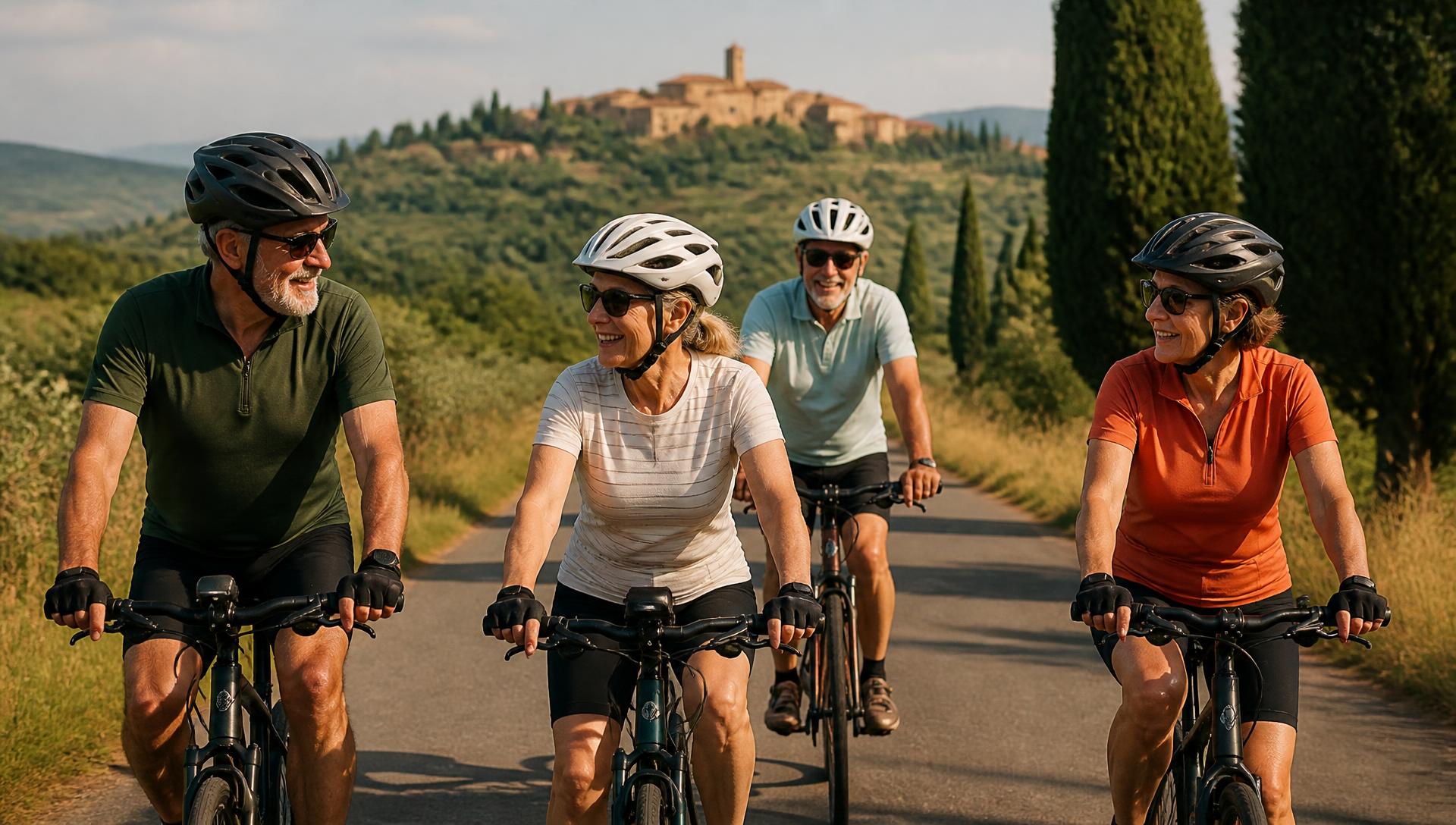
Picture two mornings in Europe.
On the first, you roll out with a small group. Your guide knows the route, the best coffee stop, the story behind the village you’re riding through and what to do if something goes wrong.
On the second, it’s just you and perhaps your partner or a few friends. You decide when to leave, where to stop and whether that little café overlooking the vineyard deserves another cappuccino.
Both can be fantastic cycling holidays.
They’re just very different ways to experience Europe.
And if you’re planning your first cycling holiday, choosing between guided and self-guided can be almost as important as deciding where to go.
So which one is right for you?
The answer has less to do with how serious a cyclist you are and much more to do with how you like to travel.
§ i
What Is a Guided Cycling Holiday?
A guided cycling holiday typically means riding with a group accompanied by a professional guide.
Routes and accommodations are organized in advance, and depending on the trip, luggage transfers, meals, mechanical assistance and support vehicles may also be included.
The biggest advantage is simplicity.
You don’t have to spend much time thinking about navigation or logistics. Your guide can also bring something GPS can’t: local knowledge.
That might mean knowing a great café for lunch, explaining the history of a village, pointing out a viewpoint you’d otherwise miss or helping when plans need to change.
Then there’s the social side.
Several days of riding, sightseeing and sharing meals can turn a group of strangers into riding companions surprisingly quickly.
For solo travellers and people who enjoy meeting others, that can be one of the best parts of a guided cycling holiday.
§ ii
What Is a Self-Guided Cycling Holiday?
Here’s where one of the biggest misconceptions appears.
“Self-guided doesn’t necessarily mean unsupported.”
On many professionally organized self-guided cycling holidays, your accommodations are arranged in advance, routes are provided through GPS or detailed navigation, and your luggage is transferred from one hotel to the next.
Support may also be available when something goes wrong.
The big difference is that you ride independently rather than following a guide and organized group.
That gives you freedom.
Want another coffee?
Stop.
See a village you’d like to explore?
Explore it.
Want to spend half an hour taking photographs beside a vineyard?
Nobody is waiting for you.
For couples, friends and independent travellers, that flexibility can be one of the biggest attractions of self-guided travel.
§ iii
There’s More Than Guided or Self-Guided
European cycling holidays actually exist along a spectrum:
DIY → Self-Guided → Supported → Fully Guided
DIY
You organize essentially everything yourself: routes, accommodations, luggage, bicycles and transportation.
For experienced bicycle travellers, that independence can be part of the adventure.
Self-Guided
Much of the planning and logistics is handled for you, but you ride independently.
For many travellers, this offers an appealing balance between freedom and support.
Supported
Supported trips fall somewhere between self-guided and fully guided, providing additional logistical or on-road assistance while maintaining some independence.
Fully Guided
A guide accompanies the group, with considerably more of the day’s navigation, logistics and decision-making handled for you.
The terminology isn’t universal. Different operators structure their trips differently, so always look beyond the label and find out exactly what’s included.
§ iv
Guided vs. Self-Guided at a Glance
- Freedom to set your own pace
- GuidedModerateSelf-GuidedHigh
- Navigation responsibility
- GuidedLowSelf-GuidedHigher
- Built-in social experience
- GuidedHighSelf-GuidedLower unless travelling with others
- Local guide knowledge
- GuidedHighSelf-GuidedMore limited
- Luggage transfers
- GuidedOftenSelf-GuidedOften
- Mechanical assistance
- GuidedGenerally greaterSelf-GuidedVaries
- Flexible start times
- GuidedLess flexibleSelf-GuidedUsually more flexible
- Spontaneous stops
- GuidedSome flexibilitySelf-GuidedHigh
- Solo travellers
- GuidedExcellent for meeting peopleSelf-GuidedDepends on preference
- Couples and friends
- GuidedGoodSelf-GuidedExcellent
- First cycling holiday
- GuidedExcellentSelf-GuidedCan also be excellent
- Cost
- GuidedUsually higherSelf-GuidedOften lower
| Consideration | Guided | Self-Guided |
|---|---|---|
| Freedom to set your own pace | Moderate | High |
| Navigation responsibility | Low | Higher |
| Built-in social experience | High | Lower unless travelling with others |
| Local guide knowledge | High | More limited |
| Luggage transfers | Often | Often |
| Mechanical assistance | Generally greater | Varies |
| Flexible start times | Less flexible | Usually more flexible |
| Spontaneous stops | Some flexibility | High |
| Solo travellers | Excellent for meeting people | Depends on preference |
| Couples and friends | Good | Excellent |
| First cycling holiday | Excellent | Can also be excellent |
| Cost | Usually higher | Often lower |
The important words here are often, usually and varies.
Always compare the actual inclusions of individual trips.
§ v
Which Is Better for Your First Cycling Holiday?
A guided trip can provide considerable peace of mind.
You don’t have to be confident navigating unfamiliar roads, and someone is nearby when questions arise.
But that doesn’t automatically make guided better.
A well-organized self-guided holiday can also be a great introduction to cycling travel, particularly when the route is straightforward and good local support is available.
The choice often comes down to your personality as a traveller.
If navigating independently sounds stressful, guided may be more enjoyable.
If following a group schedule sounds restrictive, self-guided may suit you beautifully.
And if you’re wondering whether you’re ready for the riding itself — the daily distances, the hills, the consecutive days — that’s a separate question worth answering first: how fit do you need to be for a cycling holiday in Europe?
If this is your first trip of this kind, it’s also worth reading your first cycling holiday in Europe: 15 things to know before you book.
§ vi
What If You’re Worried About Getting Lost?
Modern self-guided trips frequently provide GPS routes, digital maps or detailed route information.
That has made independent cycling much easier.
But technology isn’t perfect.
Phones lose power. Roads close. Turns get missed.
Before booking, ask:
If I get lost or can’t follow the planned route, who can I contact?
Knowing the answer before you leave can provide a lot of confidence once you’re on the road.
§ vii
What Happens to Your Luggage?
This is one of the pleasant surprises for many first-time cycling travellers.
On many organized cycling holidays, you don’t need to carry a week’s worth of clothing on your bicycle.
Instead, luggage transfers are arranged between accommodations.
You leave your main bag at your hotel and ride with only what you need for the day.
By the time you arrive at the next hotel, your luggage is there too.
It’s one of the services that can make a multi-day cycling holiday feel much more like a vacation than an expedition.
§ viii
What Happens If Your Bike Breaks Down?
This is an important question to ask before booking.
On a guided or supported trip, assistance may be relatively close.
On a self-guided trip, the level of mechanical support varies considerably between operators. Some provide telephone support and help coordinate repairs or transportation when necessary.
Ask:
What happens if I get a flat tire or have a mechanical problem and can’t continue?
Don’t wait until you’re standing beside a bicycle somewhere in rural Europe to discover the answer.
§ ix
What If You Don’t Want to Ride One Day?
Maybe it’s raining.
Maybe your legs are tired.
Maybe you’ve discovered a beautiful town and would rather spend the afternoon exploring.
Or perhaps lunch is going exceptionally well.
You’re on vacation.
Depending on the itinerary, it may be possible to shorten a route, use a train or taxi, arrange a transfer or skip a section.
If flexibility matters to you, ask about these options before booking.
§ x
What If You and Your Travel Partner Ride at Different Speeds?
This is more common than you might think.
One person may cycle regularly while the other rides occasionally. One may enjoy climbing hills while the other would rather enjoy the scenery.
That doesn’t mean you can’t enjoy a cycling holiday together.
Self-guided itineraries can offer more flexibility because you’re not trying to maintain the pace of a larger group.
E-bikes have also changed the equation.
One traveller can often use an e-bike while another rides a traditional bicycle, allowing people with different fitness levels to enjoy the same journey together.
If you’re considering that option, read E-Bike or Regular Bike for a Cycling Holiday in Europe?
The best bicycle isn’t necessarily the fastest one.
It’s the one that helps you enjoy the experience.
§ xi
Which Is More Social?
Guided cycling holidays have a natural advantage here.
You meet people.
You ride together.
You stop together.
You share stories over dinner.
And after several days together, there’s a good chance you’ll have accumulated a few inside jokes too.
For solo travellers, the built-in community of a guided trip can be especially appealing.
Self-guided doesn’t have to mean antisocial.
For couples or groups of friends, it can create a completely different kind of shared experience because the day belongs to you.
Ask yourself:
Do I want to meet my travelling companions on the trip, or bring them with me?
§ xii
Which Is More Expensive?
Guided cycling holidays generally cost more because additional services may be included, such as professional guides, group logistics, support vehicles and meals.
Self-guided trips can often cost less while still providing accommodations, route planning and luggage transfers.
But don’t compare headline prices alone.
Compare what’s actually included.
A less expensive trip isn’t necessarily better value if you’re arranging bicycles, transfers, luggage transportation and other services separately.
§ xiii
Choose Guided If…
A guided cycling holiday may suit you if you:
- Enjoy meeting new people
- Don’t want to worry about navigation
- Value local knowledge
- Want greater assistance when something goes wrong
- Are travelling solo and would enjoy companionship
- Prefer having more of the logistics handled
§ xiv
Choose Self-Guided If…
A self-guided cycling holiday may suit you if you:
- Are travelling with a partner or friends
- Like setting your own pace
- Enjoy independent travel
- Are comfortable following GPS navigation
- Want flexibility throughout the day
- Love stopping whenever something catches your attention
And if your perfect cycling day includes a two-hour lunch?
That’s useful information too.
§ xv
Before Booking a Self-Guided Cycling Holiday, Ask These Questions
- 1Is luggage transferred between hotels every day?
- 2What navigation system is provided?
- 3Can the navigation be used offline?
- 4What happens if I get lost?
- 5What mechanical support is available?
- 6What happens if I can’t finish the day’s ride?
- 7Can routes be shortened or modified?
- 8Are e-bikes available?
- 9What types of roads, paths or trails will I be riding?
- 10What level of accommodation is included?
- 11Is there a local emergency contact?
- 12Which meals are included?
- 13Can one traveller use an e-bike while another uses a regular bike?
The answers may tell you more about the experience than the words guided or self-guided ever will.
§ xvi
Still Not Sure? Ask Yourself These Seven Questions
- 1Do I enjoy travelling with a group?
- 2How comfortable am I navigating independently?
- 3How important is riding at my own pace?
- 4How much support do I want if something goes wrong?
- 5Am I travelling solo, as a couple or with friends?
- 6How important is having a local guide?
- 7How much flexibility do I want during each day?
Your answers will usually start pointing you in the right direction.
§ xvii
Choose the Experience First. Choose the Tour Second.
It’s tempting to begin planning a European cycling holiday by choosing the destination.
Italy sounds wonderful.
So do Portugal, Croatia, France, Spain, Austria and the Netherlands.
But before deciding where to go, think about how you want your days to feel.
Do you picture riding with new friends and sharing dinner afterward?
Or setting off with your partner in the morning, stopping whenever something catches your attention and arriving at your next hotel when you’re ready?
Neither experience is better.
They’re simply different.
And choosing the one that fits you can make the difference between taking a cycling trip and having a cycling holiday you’ll talk about for years.
§ xviii
Frequently Asked Questions
Are self-guided cycling holidays suitable for beginners?
They can be. Look for manageable daily distances, appropriate terrain, straightforward navigation, luggage transfers and good operator support.
Do self-guided cycling holidays include luggage transfers?
Many professionally organized trips do, but not all. Always confirm what’s included.
Do I need to know how to repair a bicycle?
That depends partly on the support provided by your operator. Knowing a few basics can provide extra confidence, but some operators provide assistance or help coordinate repairs.
Can I use an e-bike?
Many European cycling holidays offer e-bike options. Availability varies by itinerary and operator.
Is guided better for solo travellers?
Guided trips can be particularly appealing for solo travellers because they provide a built-in group and social environment. Independent travellers may also enjoy self-guided holidays.
Is a cycling holiday a race?
Absolutely not.
For most recreational cycling holidays, the objective isn’t to arrive first.
It’s to experience everything between where you started and where you’re going.