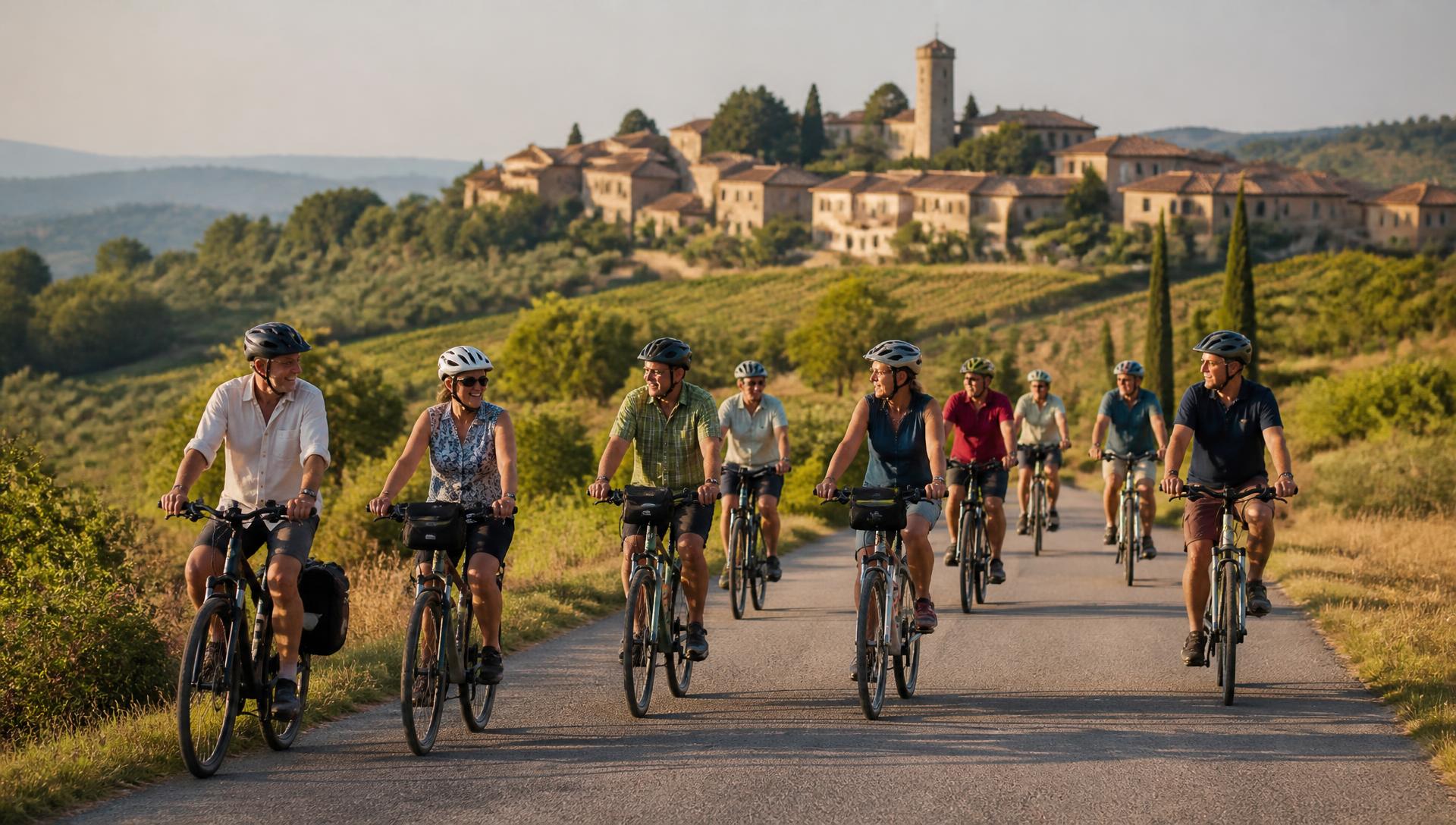
There is a moment that happens in a lot of cycling groups.
You’re sitting around after a ride, usually with coffee or something to eat, and somebody says:
“We should do a cycling trip in Europe.”
Everyone agrees.
Someone mentions Italy.
Someone else says Portugal.
Another rider has always wanted to cycle along the Danube.
And before long, what started as a casual conversation begins to sound like something that could actually happen.
Then come the questions.
How far would we ride each day?
How hilly is it?
Should we bring our bikes?
Can we rent good road bikes?
What about e-bikes?
Where does the luggage go?
What happens if someone doesn’t want to ride one day?
Can spouses or partners come if they don’t cycle?
Should the trip be guided?
Who’s going to organize all of this?
That’s the point where a great cycling idea can start becoming a fairly serious project.
The good news is that it doesn’t have to.
§ i
Start With Your Riders, Not Europe
Europe gives cyclists an almost overwhelming number of choices.
Italy.
Portugal.
Spain.
France.
The Netherlands.
Austria.
Germany.
Croatia.
Slovenia.
And dozens of regions within each country that could make a wonderful cycling holiday.
So choosing a destination shouldn’t actually be your first decision.
Your first question should be:
“What kind of cyclists are we?”
A group that regularly rides 100 kilometres at a strong pace will probably want something very different from a social cycling club that prefers 40 to 60 kilometres with café stops along the way.
Think about:
Typical ride distance.
Average pace.
Comfort with climbing.
Experience riding consecutive days.
Road versus trail preference.
How important sightseeing is.
How much time people want off the bike.
Whether riders want a challenge or primarily a holiday.
There’s a big difference between travelling to Europe to cycle and using cycling as a wonderful way to experience Europe.
Neither approach is better.
But everyone should have roughly the same expectation before the trip begins. If it helps, our guide to how fit you need to be for a cycling holiday in Europe is a useful conversation starter for the group.
§ ii
This Isn’t a Training Camp
For many recreational cyclists, the best European cycling holiday isn’t the one with the biggest numbers.
It is the one where the cycling fits naturally into the day.
Ride through vineyards.
Stop for coffee in a village square.
Explore a historic town.
Have lunch somewhere you never would have discovered from a tour bus.
Ride another beautiful stretch of countryside.
Then finish the day with dinner, wine and stories about what happened along the way.
The bicycle becomes part of the experience rather than the entire purpose of the trip.
“This isn’t a training camp. It’s a European holiday experienced by bicycle.”
That distinction matters.
A successful club trip should leave people remembering the landscapes, meals, conversations and places they discovered, not simply the kilometres they completed.
§ iii
Don’t Judge Difficulty by Distance Alone
A 50 kilometre ride can be easy.
It can also be very difficult.
Elevation matters.
So does road surface.
Traffic matters.
Heat matters.
Wind matters.
And riding five days in succession feels different from riding once or twice a week at home.
A group accustomed to a comfortable 60 kilometre Sunday ride shouldn’t automatically assume that six consecutive 60 kilometre days will feel the same.
When comparing cycling holidays, look beyond the daily kilometre number.
Ask about:
Total climbing.
Maximum gradients.
Road surfaces.
Technical sections.
Traffic levels.
Length of the longest day.
Number of consecutive riding days.
Rest day options.
Vehicle or other support.
The objective isn’t to find the hardest trip your strongest riders can survive.
It’s to find a trip the whole group will enjoy.
§ iv
Different Riders Can Still Share the Same Journey
Almost every recreational cycling group has different levels.
There’s the person who attacks every hill.
There’s the steady rider.
There’s the cyclist who’s happiest chatting at the back.
Someone loves 80 kilometres.
Someone thinks 50 is plenty.
That doesn’t automatically mean they can’t travel together.
Sometimes the solution is different daily route options.
Sometimes riders divide naturally into smaller pace groups.
Sometimes a support vehicle creates flexibility.
And increasingly, the answer can be an e-bike.
Modern e-bikes can allow people with different fitness levels to share the same cycling experience without forcing everyone to ride at exactly the same physical intensity.
A strong traditional cyclist and a recreational e-bike rider may be able to enjoy the same countryside, stop at the same cafés and arrive at the same destination together.
That’s one reason I don’t think a cycling holiday should become a test of who is the strongest rider.
“The purpose is to share the experience.”
§ v
E-Bike or Regular Bike?
This question deserves an honest conversation before anyone books, and it’s worth reading our full comparison of e-bikes and regular bikes together as a group.
Some cyclists naturally want their regular road bike experience.
Others may prefer an e-bike because they want to enjoy consecutive cycling days without worrying about every climb.
Both can belong on the same trip.
If your group includes e-bikes, confirm beforehand that:
Suitable e-bikes are available.
Battery range comfortably covers the routes.
Charging arrangements are available.
Bike sizes are appropriate.
The route and pace work for both bike types.
And if you’re travelling overseas, renting an e-bike is generally far simpler than attempting to fly with an e-bike battery.
The important part is removing ego from the decision.
The best bicycle for a cycling holiday is usually the bicycle that helps someone enjoy the holiday.
§ vi
Should You Bring Your Own Bike?
Cyclists can have strong feelings about this one.
There’s something reassuring about riding your own bicycle.
You know the fit.
You know the saddle.
You know the brakes and shifting.
And for performance oriented trips, bringing your own road bike may make sense.
But flying with a bike also means dealing with:
A bike case.
Airline policies and fees.
Airport transportation.
Assembly and disassembly.
Potential damage.
Storage of the case during the trip.
And transporting everything at the end.
For many recreational cycling holidays, quality rental bikes can make the experience dramatically easier.
Before renting, ask specifically about:
Bike brands and models.
Available sizes.
Road, hybrid and e-bike choices.
Pedals.
Saddles.
Gearing.
Maintenance.
Replacement support if something goes wrong.
“Bike included” doesn’t tell you enough.
For cyclists, the quality and condition of that bike matters.
§ vii
Guided or Self-Guided?
Both can be excellent.
A self-guided cycling holiday usually gives you more independence.
Routes can be provided through GPS navigation while accommodations and luggage transfers are arranged for you.
You ride largely at your own pace.
Stop when you want.
Spend an extra half hour at the café.
Take photos.
Explore.
A guided trip adds another level of support.
A good guide can help with navigation, mechanical problems, local knowledge, pacing, restaurants, cultural interpretation and the dozens of little issues that inevitably come up during a cycling trip.
For a club travelling together for the first time in an unfamiliar country, that support can be particularly valuable. Our Cycling Adventures collection includes both styles.
There isn’t one correct answer.
Ask your group:
“Do we want maximum independence or maximum simplicity?”
That usually moves the decision in the right direction.
§ viii
Centre-Based or Place-to-Place?
This decision changes the feel of the entire holiday.
A centre-based trip keeps the group in one hotel or accommodation and uses different cycling loops each day.
The advantage is simplicity.
Unpack once.
Take a rest day easily.
Choose a shorter ride if needed.
Leave something in your room without worrying about seeing it again three hotels later.
Place-to-place cycling feels more like a journey.
You ride from one destination to another while your luggage is transported separately.
There’s something incredibly satisfying about arriving in a new town knowing you got there by bicycle.
But it also requires more logistics.
For an experienced travel provider, those logistics are routine.
For one volunteer cycling club member trying to organize everyone else’s vacation, they can become a lot of work.
§ ix
And Then There’s Bike & Boat
For some cycling clubs, bike and boat travel may be one of the best introductions to European cycling travel.
Instead of changing hotels, your accommodation travels with you.
You cycle during the day.
The boat moves between destinations.
You return to the same cabin.
You unpack once.
And the experience doesn’t necessarily require every traveller to cycle every kilometre.
That can make a bike and boat journey especially interesting for mixed groups, couples and communities where not everyone has exactly the same cycling ambitions.
It’s one of the reasons this style of travel has become such an interesting intersection between cycling and cruising.
§ x
Think About the Non-Cyclists Too
Here’s a question cycling groups sometimes forget:
“What about the partners?”
Maybe one member loves cycling and their spouse doesn’t.
That doesn’t necessarily mean they need separate vacations.
Certain destinations and trip styles work much better for mixed couples than others.
An active river cruise, for example, can allow one person to ride while the other chooses sightseeing, walking or another excursion.
Bike and boat itineraries may offer more flexibility than a pure point-to-point road cycling tour.
Centre-based stays in attractive towns can also give non-riders plenty to do.
If partners are likely to join, make that part of the planning conversation early.
It can significantly increase both participation and enjoyment.
§ xi
Choose the Season as Carefully as the Destination
A beautiful cycling destination isn’t necessarily beautiful for cycling twelve months of the year.
Heat can transform a pleasant route into a difficult one.
Rain patterns matter.
Crowds matter.
So do hotel prices and availability.
For many southern European cycling regions, spring and autumn can be especially attractive because temperatures are often more comfortable for active travel.
The ideal month will depend on the region.
Instead of saying:
“Let’s go to Italy.”
Ask:
“Where in Europe offers the kind of cycling we want at the time of year we can travel?”
That’s a much better planning question.
§ xii
Don’t Forget What Happens Off the Bike
This is where I think cycling holidays sometimes get misunderstood.
A great cycling trip isn’t just a collection of rides.
You’re travelling.
That means coffee in a village square.
Local food.
Wine with dinner.
Historic towns.
Markets.
Architecture.
People.
Culture.
And the simple pleasure of sitting around after a ride talking about the day.
For many recreational cyclists, those moments become just as memorable as the kilometres.
So when evaluating a trip, don’t only examine the route map.
Look at the whole day.
Where will you stop?
Where will you stay?
What will you see?
What happens in the evening?
Would you still enjoy being there if you weren’t wearing cycling shoes?
That’s usually a good sign you’ve chosen the right place.
§ xiii
How Many People Do You Need?
You don’t necessarily need an enormous cycling club.
Small groups can work beautifully.
The right number depends on the itinerary, accommodation, transportation, bike availability and whether you’re arranging a private departure.
The more important first step is identifying genuine interest.
There’s a big difference between:
“That sounds amazing.”
and
“Yes, I would seriously consider travelling.”
Start with a small core of genuinely interested riders.
Learn what they want.
Then build from there.
For a closer look at supplier minimums, smaller groups and what actually counts as group travel, read How Many People Do You Need for a Group Trip?.
§ xiv
Don’t Let One Club Member Become Everyone’s Travel Department
Cycling clubs usually already have someone who brings people together.
The ride organizer.
The person who posts the routes.
The person everyone asks about the weekend ride.
The person who somehow ends up booking the restaurant.
That person may be the natural leader for a European cycling experience.
But they shouldn’t necessarily have to become everyone’s travel agent too.
That’s the thinking behind the PEDAL & PORT Community Host idea.
The Community Host knows the people.
They understand the group.
They help create enthusiasm and bring the community together.
PEDAL & PORT can help explore the travel side and connect the idea to an experience that makes sense for the group — the kind of shared journeys you’ll find in our Hosted Experiences collection.
The Cycling Holiday Playbook
Planning a Cycling Holiday?
34 pages. 22 chapters. 3 PEDAL & PORT planning tools.
Get the Free Playbook“You bring the community. We help bring the journey to life.”
§ xv
Your First Conversation Doesn’t Need an Itinerary
If your cycling club has talked about travelling together, you don’t need to begin with dates, deposits and hotel contracts.
Start with five questions.
Where would we love to ride?
How far would we genuinely enjoy cycling each day?
How important are food, sightseeing and culture?
Would we prefer guided, self-guided, bike and boat or another style?
Who would seriously consider coming?
That’s enough to start.
The trip can come later.
Because sometimes a European cycling adventure begins exactly where your regular rides already do.
A group of cyclists.
A cup of coffee.
And somebody saying:
“You know what we should do someday?”
Maybe someday is worth exploring.