§ i
Travel That Gets You Closer
There are trips where the destination waits for you at the end of the journey.
And then there are trips where the journey itself keeps inviting you to step outside, look closer and wonder what might be around the next headland.
Expedition cruising belongs in the second category.
You still travel by ship. You still unpack once. You still have a comfortable place to return to at the end of the day.
But the purpose feels different.
The ship isn’t necessarily where the most memorable moments happen. It’s what allows you to reach them.
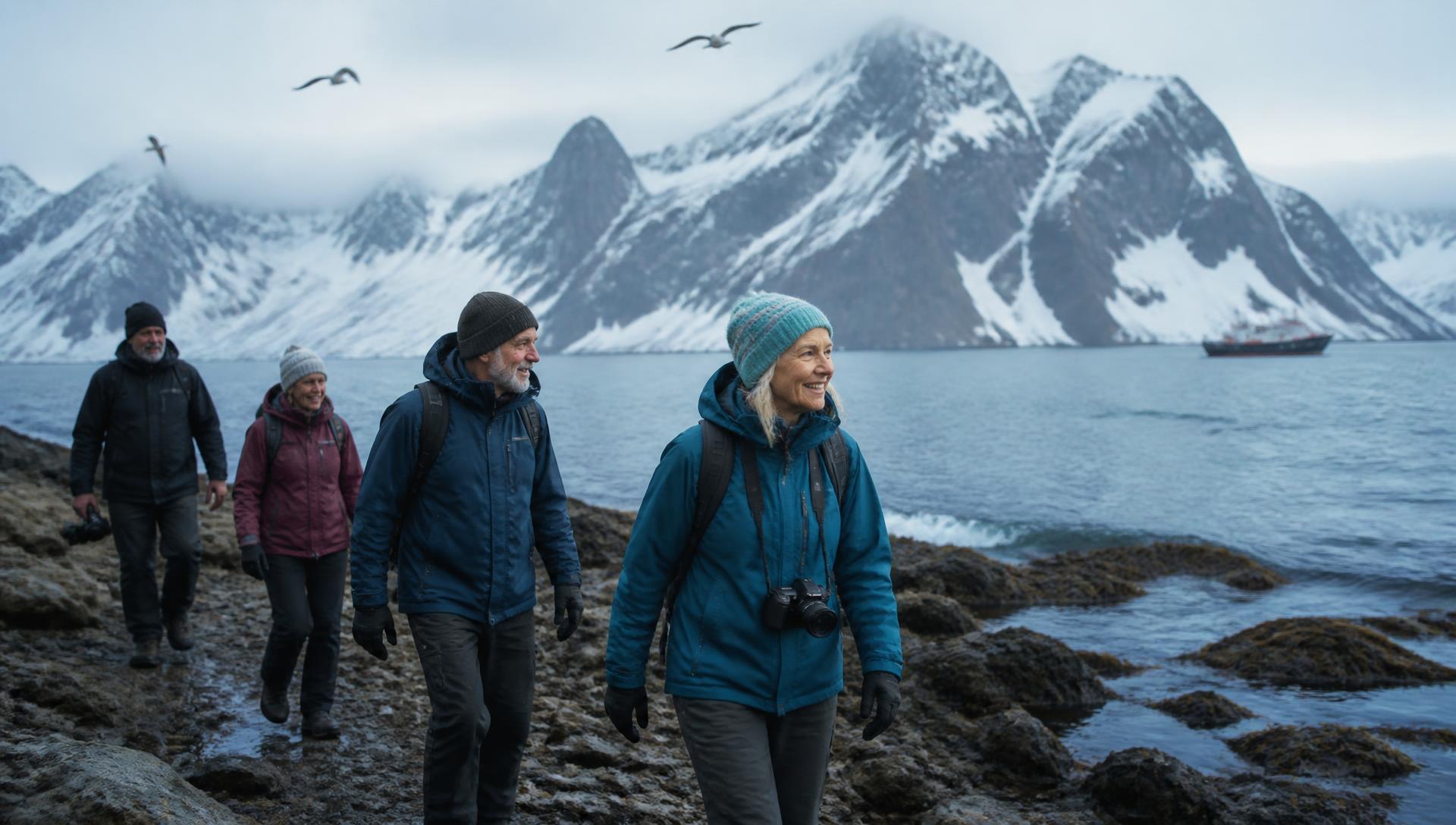
A remote shoreline. A quiet bay explored by Zodiac. Wildlife where it actually lives. A walk through a landscape few people ever experience. A conversation that gives you a completely different understanding of the place you’re visiting.
That’s expedition cruising.
And despite the images of Antarctica and serious-looking explorers that often surround it, expedition travel is much broader and more approachable than many people realize.
§ ii
So, What Exactly Is an Expedition Cruise?
An expedition cruise is a smaller-ship journey designed around exploration, discovery and access to destinations that can be difficult to experience through conventional travel.
Instead of sailing primarily between established cruise ports, expedition ships can take travellers closer to remote coastlines, islands, wildlife habitats and communities.
There’s usually an expedition team onboard too.
Depending on the journey, that might include naturalists, historians, scientists, photographers, cultural interpreters and other specialists who help you understand what you’re experiencing.
And because nature doesn’t follow a timetable, flexibility is part of the adventure.
Weather changes.
Wildlife moves.
Conditions evolve.
Sometimes plans change because an unexpected opportunity is simply too good to miss.
That uncertainty isn’t necessarily a drawback.
It can be part of what makes expedition travel memorable.
§ iii
How Is It Different From a Traditional Cruise?
Traditional cruising and expedition cruising can both be wonderful ways to travel. They’re simply designed around different priorities.
On many traditional cruises, the ship itself is a major part of the vacation. Entertainment, dining, pools, activities and onboard amenities are central to the experience. If that sounds more like your kind of holiday, an ocean cruise may be the more natural fit — neither style is better, they simply answer different wishes.
Expedition cruising shifts more of the emphasis toward where the ship can take you and what you can experience once you get there.
Ships are generally smaller. Destinations can be more remote. Shore experiences tend to be more immersive. Expedition teams play a much larger role.
And instead of always walking down a gangway into a conventional port, you might find yourself climbing into a Zodiac and heading toward a shoreline that doesn’t have a dock at all.
It’s a different rhythm of travel.
§ iv
What Do You Actually Do?
This is where expedition cruising starts getting interesting.
Depending on the destination and operator, a day might include exploring by Zodiac, walking or hiking ashore, kayaking, wildlife viewing, photography, cultural encounters or attending talks with members of the expedition team.
You might spend one morning quietly watching wildlife and the afternoon learning about the geology, history or culture of the region.
The next day could be completely different.
Activities vary significantly by destination, ship, itinerary, weather and individual ability, so no single list describes every expedition.
That’s part of the appeal.
You’re not simply travelling through somewhere.
You’re being given different ways to experience it.
§ v
Do You Have to Be Really Fit?
This may be one of the biggest misconceptions about expedition cruising.
The word expedition can make it sound as though you need to be preparing for an endurance event.
You don’t.
Some expedition travellers absolutely want the most active experience available. They’ll choose the longer hike, sign up for kayaking and look for every opportunity to get outside.
Others prefer Zodiac exploration, shorter walks, wildlife viewing, photography, cultural experiences or educational programs.
The important thing is understanding the physical requirements of a particular itinerary before booking. It’s the same question I find myself asking about the water in Europe, in how active an active river cruise really is.
Different expeditions can require very different levels of mobility and activity.
And you don’t necessarily have to participate in every activity.
You don’t have to do everything to experience everything.
For active travellers, that flexibility can be especially appealing. You can choose a journey that challenges you a little without turning your vacation into an athletic competition.
§ vi
Expedition Doesn’t Just Mean Antarctica
Antarctica may be expedition cruising’s most recognizable destination.
And understandably so.
But expedition cruising has expanded far beyond the polar regions.
The Arctic and Greenland offer dramatic fjords, wildlife, remote landscapes and northern cultures.
Canada has extraordinary expedition possibilities of its own, including Baffin Island and the Northwest Passage.
The Galápagos offers an entirely different experience built around remarkable wildlife and natural history.
Then there are destinations such as Patagonia, Australia’s Kimberley and remote parts of Indonesia and the South Pacific.
So if you’re intrigued by expedition travel but have absolutely no desire to pack a parka, don’t dismiss the category.
There’s much more to it than ice.
§ vii
What About the Ship?
This is another area where expedition cruising has changed considerably.
There’s no single “expedition ship.”
Some vessels are deliberately adventure-focused and relatively simple.
Others emphasize science, education and natural history.
And at the premium end of the market, some ships combine serious exploration with beautiful accommodations, sophisticated dining and a very high level of onboard comfort.
That variety is good news.
It means choosing an expedition isn’t simply about deciding where you want to go.
It’s also about deciding how you want to travel.
For one person, luxury might mean an exceptional suite and dinner at the end of the day.
For someone else, luxury might be standing on a remote shoreline with only a handful of other people around.
Both can be extraordinary.
§ viii
How Do You Choose the Right Expedition?
This is where I think people sometimes start in the wrong place.
They start with the cruise line.
I’d start with you. It’s the same approach I take when people ask me to compare a river cruise, an active river cruise and a bike & boat trip.
1
Where have I always wanted to go?
Start with the place that keeps coming back to you.
2
What do I want to experience when I get there?
Wildlife, landscape, culture, learning — or a little of each.
3
How active do I want my days to be?
Be honest about the pace you would actually enjoy.
4
Is wildlife important to me?
Some itineraries are built around it; others aren’t.
5
Do I want culture, history and education to be a major part of the journey?
The expedition team can shape the experience as much as the destination.
6
How much onboard comfort matters to me?
Expedition ships range from simple and adventure-focused to genuinely refined.
7
How much time do I have?
Remote places often need travel days on either end of the sailing.
Once those answers become clearer, comparing destinations, itineraries, ships and operators becomes much easier.
The best expedition isn’t necessarily the newest ship, the most luxurious ship or the journey with the longest list of activities.
It’s the expedition that fits the way you want to experience the world.
§ ix
Travel With Curiosity. Explore With Respect.
There’s another side of expedition travel that’s becoming increasingly important.
Many of the places expedition ships visit are extraordinary precisely because they remain relatively remote.
They may contain fragile ecosystems, important wildlife habitats, Indigenous and local communities, historic sites and cultural traditions deserving of respect.
Getting closer comes with responsibility.
That means following wildlife guidelines, listening to local perspectives, respecting cultural sites and recognizing that we’re visitors in someone else’s home or in an environment that deserves protection.
The goal shouldn’t simply be to collect another destination.
It should be to leave understanding it a little better.
§ x
Could Expedition Cruising Be for You?
I think the answer has less to do with whether you consider yourself an “adventurer” and more to do with what you enjoy about travel.
Do your favourite travel memories come from seeing something you didn’t expect?
Do you enjoy being outside?
Are you curious about wildlife, landscapes, history or different cultures?
Do you like learning while you travel?
Would you rather experience a destination than simply say you’ve visited it?
If several of those sound familiar, expedition cruising may be worth exploring.
Because ultimately, expedition travel isn’t about going somewhere just because it’s difficult to reach.
It’s about what happens when you get there.
Sometimes the most memorable travel experiences begin when you stop watching the world from a distance and step into it.